


 花研コーヒーブレイク
脳は情報が圧縮されていると快適らしい
2026.09.03
こんにちは。花研の一研究員です。
花や緑には様々な効果があると言われています。
効果対象は、「からだ(生理)、こころ(心理)、あたま(認知)、つながり(社会)」の4つに大別されるでしょう。
それぞれについてこれまでの研究蓄積量はまちまちで、4つとも完全に科学的に解明されたというところには至っていませんが、まあ近いうちに解明される
のではないかと。
今回はその中でも「あたま」、つまり認知に関する話です。
最近読んだ『ネイチャー・エフェクト』(マーク・G・バーマン著)は、自然と脳の関係を扱った本です。著者はシカゴ大学の神経科学者で、特に自然環境が認知疲労を回復させるメカニズムを研究しています。
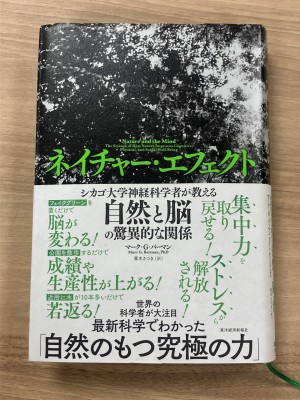
この本を読んでいて面白かったのは、「自然は脳にとって処理しやすい情報である」ということ。
普通に考えると森は情報だらけです。木も葉も枝もあり、風も光も動いています。連続した情報は不規則で、情報量だけでいけば都会の直線的なビル街より多いように思います。
ところが脳はそう受け取っていないらしいのです。
葉の付き方・枝の茂り方には大小の繰り返しパターンが多数あり、繰り返しは情報として圧縮できるのです。
左右に枝が出て、また左右に・・・という具合に同じようなパターンを繰り返すことで一本の木が枝を伸ばし何mにもなり、同じように成長した植物が何十も
視覚情報としてインプットすると、実は脳にとっての情報量は少なく、疲れないそうです。自然界にあらわれる繰り返しのことをフラクタルって繰り返しパターンだったんだ・・・。
ちょうどその本を読んだころに、NHKテレビ番組「ちこちゃんに叱られる」を視聴しました。
その放送回で紹介されていたのが「ゲシュタルト心理学」でした。難しそうな名前ですが、その理論をざっくりと説明しますと、人は部分の集合ではなくまず全体像として物事を理解するという理論です。
例えば大人数のダンスや阿波踊りがぴったり揃っていると美しく見える、それはなぜかというとゲシュタルト心理学的にいえばそろった動きの方がそろっていない動きよりも「ひとつのまとまり」として認識しやすく、脳の処理負荷が少ないためだということでした。
バーマンの本と同じく、ゲシュタルト心理学でも脳の情報処理という概念がでましたね。
私にはこれら二つの説明が脳の同じ性質を示すものだと思えました。バーマンの理論とゲシュタルト心理学は脳の特徴をそれぞれの方法で解いたのだろうと思いました。そして、脳の処理負荷を下げるということが花き分野でも証明できるのかもしれないと考えました。
美しい花束は、花の種類や色数が多くても、不思議とごちゃごちゃして見えません。デザインの繰り返しやリズム、焦点、規則性があり、脳が全体像として理解しやすいからだという仮説を立てることができます。
「花はなぜ癒やすのか」ではなく、「どのような構造の花や花束が脳の情報処理負荷を抑えるのか」なのかもしれません。
なーんて、今日はちょっと真面目風に考えてみました。
そう言われてみると、部屋が片付いていると気持ちがすっきりしますが、散らかっている部屋を見るとなんとなく疲労感が溜まるのもそういうことに関係しているのかもしれません。
花や緑の装飾も含め、疲れない環境づくり、大切ですね。
頭がすっきり整理されたところで、「フラワービジネスノート2027」もご利用ください。
9月16日発売です。
それではみなさま、ごきげんよう。
Why Do Flowers Make Us Feel Better?
A Brain Science Perspective
Hello, this is OTA Floriculture Research Institute.
Flowers and greenery are said to have many beneficial effects on people.
These effects can broadly be divided into four categories:
- The body (physiological effects)
- The mind (psychological effects)
- The brain (cognitive effects)
- Social connections (social effects)
Research into these areas has progressed at different speeds, and none of them have been completely understood from a scientific standpoint yet. Still, it seems likely that science will continue to uncover more answers in the near future.
Today, I’d like to focus on the third category: the brain, or more specifically, cognition.
Recently, I read “The Nature Fix” by neuroscientist Marc G. Berman, a professor at the University of Chicago. His research explores how natural environments help restore our ability to concentrate and recover from mental fatigue.
One idea from the book particularly caught my attention:
Nature provides information that is easy for the brain to process.
At first glance, that seems counterintuitive. A forest appears full of information. There are trees, branches, leaves, wind, shadows, and constantly changing patterns of light. Compared with the straight lines and simple geometry of a city, nature seems much more visually complex.
Yet our brains apparently perceive it differently.
The arrangement of leaves and branches contains countless repeating patterns at different scales. Because repetition can be compressed into recognizable patterns, the brain does not need to process every detail individually. A tree grows by repeating similar branching structures over and over again. A landscape filled with many plants displaying similar growth patterns may actually present less cognitive demand than we might expect.
This was the point at which I realized what the word “fractal” really means in nature: repeating patterns occurring at different scales.
Around the same time I was reading Berman’s book, I happened to watch a television episode of NHK’s popular program Chiko-chan ni Shikarareru!.
The program introduced the concept of Gestalt psychology.Although the name sounds complicated, the basic idea is quite simple: people tend to perceive things as whole patterns before noticing their individual parts.
For example, a large group dance or a traditional Awa Odori performance appears beautiful when everyone’s movements are perfectly synchronized.
Why?
According to Gestalt psychology, synchronized movements are easier for the brain to recognize as a single coherent unit than random, disconnected movements. As a result, the brain requires less effort to process what it sees.
Interestingly, this idea also revolves around information processing in the brain.
To me, Berman’s theory and Gestalt psychology seem to be describing the same underlying characteristic of human perception from different perspectives.
Both suggest that the brain prefers order, patterns, and structures that can be efficiently processed.
That made me wonder whether a similar principle might apply to flowers. A beautiful bouquet can contain many flower varieties and numerous colors, yet it surprisingly does not appear chaotic.
Perhaps repeating forms, rhythms, focal points, and patterns within floral design allow the brain to understand the arrangement as a coherent whole.
If so, the question may not simply be:
“Why do flowers make us feel relaxed?”
Instead, it may be:
“What kinds of flowers, plants, or floral designs reduce cognitive load and make information easier for the brain to process?”
Well, perhaps I’ve become a little too serious today!
But now that I think about it, the same principle may help explain why a tidy room feels refreshing while a cluttered room can leave us feeling mentally exhausted. Maybe our brains are constantly working to process the visual information around us.
Creating environments that are gentle on the mind, including thoughtful use of flowers and greenery, may be more important than we realize.
Now that your thoughts are nicely organized, perhaps it’s a good time to take a look at Flower Business Note 2027 as well.
The new edition will be released on September 16, and advance orders are now being accepted through the Hanaken Shop.
We hope you’ll find it a useful companion throughout the coming year.
Until next time, take care and stay well.
