


 花研コーヒーブレイク
小花とバーティカルデザインが同居した花とは
2026.09.04
こんにちは。花研の一研究員です。
この度も花き専門デジタルマガジン「フローラルデイリー」ネタです。
記事はこちら⇓
オランダの種苗会社コルスターがプランタリウム「グロエン・ディレクト」で8種類の新しい園芸植物を紹介します。
コルスター社が新しい草花類を紹介しています。その中に目を疑わんばかりの写真と説明があります。
なんと、すらりと伸びて「赤く」小さな花序を無数につけるタイプのエリンジウムが存在するではありませんか!
小花の集散花序によるボリューム感、ステムのバーティカル感を同時に実現した新しいタイプのアイテムです。しかもこれがエリンジウムとは!
で、はたと思いつきました。
数週間前からこのアイテムを大田市場の仲卸さんで見ることがありました。
一見ワレモコウのようでもありますが、なんとなく葉やステムがワレモコウとは異なり、なんだろうと思っていたのです。商品名を見ると「エリンジウム」と書いてあったりなかったり。
いや、「エリンジウム」と書いてあるとむしろ「これ、なにかの間違えじゃ??」と思うほど、エリンジウムの面影はもはや消え失せていました。
その時に撮った写真がありました⇓ワレモコウかなにかに見えますよね・・・一見。ところがエリンジウムだって商品値札が言うのですよ。
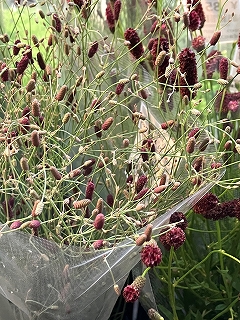
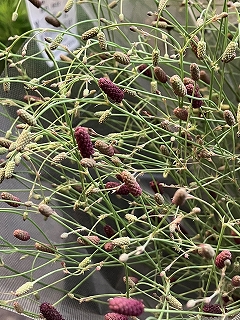
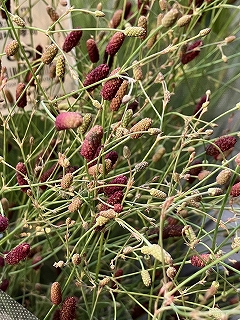
仲卸さんで見かけたこちらのエリンジウムの品種は「セレナータ」です。
マジカルレッドサンダーとはまた異なる品種ではありますが、タイプとしては近いかもしれません。青いエリンジウムよりは、・・・くらいな感じですが。
調べてみましたら、やはり青いエリンジウムと赤いエリンジウムは原種が異なるようですね。従って学名も異なります。
青いエリンジウムは、
Eryngium planum(エリンジウム・プラナム )
Eryngium alpinum(エリンジウム・アルピナム)
などが交配の元になっているようです。
一方、赤いエリンジウム「マジカルレッドサンダー」の学名は、Eryngium pandanifolium(エリンジウム・パンダニフォリウム)。
pandanifolium=パンダヌス(タコノキ)のような葉の意味
セレナータはEryngium ebracteatum var. poterioides(エブラクテアツム・バリエーション・ポテリオイデス)。
エリンジウムにはほかにも、「細長く尖った「ユッカ」のような葉」の意味を持つEryngium yuccifolium(エリンジウム・ユッカフォリウム)、白銀色の巨大な種(E. giganteum)や、アガベのような葉を持つ種(E. agavifolium)などがあり、世界に約250種以上の原種が存在しているといいます。まだ見ぬエリンジウムの新品種が近い将来誕生するかもしれません。エリンジウムもまた様々な可能性を秘めていますね。
そんな新品種の誕生を思うとき、ときどきですが世界の種苗会社が開発した新品種と私たちが提唱するトレンドが同期しすぎて驚くことがあります。もしブログを読んでいただいているとしたら光栄です。
ま、実際にはそんなことはないでしょうが、少なくともトレンドを先読みすることの重要性は実感します。
・・・ ・・・ ・・・ ・・・ ・・・ ・・・ ・・・ ・・・
ところで、もうそろそろFBN2027が発売されます。
海外からも買える越境ECも準備完了しています。実際にスウェーデンから拙著のご注文いただきました。
え?スウェーデンから注文があったの?!

私の名前リンネアは、スウェーデン出身の植物学者カール・フォン・リンネ先生の名前に由来しているんですよ。
そう、そのことをちゃんとスウェーデンのお客様に伝えて、花研のナビゲーターリンネアちゃんの写真ととともに送りいたしましたよ。
わー、そうだったのね。ありがとう!

そしたら、そのスウェーデンの方から次のようなメッセージが届きましたよ。
「リンネアちゃんの名前を見て、すぐにリンネのことが頭に浮かびました。
本当にリンネに由来していたとは、とても光栄なことです。スウェーデンの偉人の名前からとってくれてありがとうございました」
スウェーデンの方が、私の名前からすぐに本家リンネ博士を思い出してくれたとは、とてもうれしいです。ぜひ今後とも海外のみなさまにもお気軽にご利用いただければと思います。
A New Kind of Eryngium? Red, Vertical, and Full of Surprises
This story comes from the floriculture digital magazine FloralDaily.
The article can be found here: Kolster presents eight new garden plants at Plantarium Groen-Direkt
Dutch breeding company Kolster recently introduced eight new ornamental plants at Plantarium Groen-Direkt. Among them was a photograph and description that immediately caught my eye.
To my amazement, there was an Eryngium unlike any I had ever seen before: tall and elegant, covered with countless tiny red flower heads. It is a completely new type of product that combines the airy volume created by many small inflorescences with a strong vertical stem structure. And the most astonishing part? It is an Eryngium!
You can see the striking habit of Eryngium ‘Magical Red Thunder’ here.
Then I suddenly remembered something.
A few weeks ago, I had already seen a similar item at a wholesaler in the Ota Market in Tokyo.
At first glance, it looked very much like Sanguisorba (burnet). Yet the leaves and stems seemed different, and I couldn’t quite identify it. Sometimes the product label said “Eryngium,” and sometimes it did not.
In fact, when I saw the label “Eryngium,” I almost thought it must be a mistake. Its familiar thistle-like appearance had disappeared completely.
Here is a photo I took at that time. Doesn’t it look like a Sanguisorba at first glance? Yet according to the price tag, it was definitely an Eryngium.
The cultivar I saw at the wholesaler was called ‘Serenata.’
Although it is different from ‘Magical Red Thunder,’ the overall growth habit appears somewhat similar. At least it is far closer to that type than to the classic blue Eryngiums that most florists know.
When I investigated further, I discovered that the familiar blue Eryngiums and these red-flowering forms originate from different species. Naturally, their scientific names are also different.
The blue Eryngiums commonly used in cut flower breeding are often derived from species such as:
Eryngium planum
Eryngium alpinum
By contrast, ‘Magical Red Thunder’ is based on:Eryngium pandanifolium.
The species epithet pandanifolium means “having leaves like a Pandanus” (screw pine).
Another related species is:Eryngium yuccifolium
The name yuccifolium means “having leaves like a Yucca,” referring to its long, narrow, pointed foliage.
The cultivar ‘Serenata’ belongs to:Eryngium ebracteatum var. poterioides
Eryngium is a remarkably diverse genus. It includes giant silvery species such as Eryngium giganteum, as well as species with agave-like foliage such as Eryngium agavifolium. With more than 250 species found throughout the world, there may be many new forms waiting to be discovered and developed.
This makes me wonder what future Eryngiums might look like.
Whenever I see a new cultivar like this, I am sometimes surprised by how closely the work of plant breeders around the world aligns with the trends we discuss and predict in our own research. If plant breeders are reading our blog, I would be truly honored.
Perhaps that is wishful thinking.
Still, it reminds me how important it is to anticipate future trends.
The Flower Business Note 2027 will be released very soon.
We have also completed preparations for international e-commerce, making it possible for customers overseas to purchase the book directly.
In fact, we recently received an order from Sweden.
“Really? An order from Sweden?”
That’s exactly what Linnea, our Flower Life Research Institute navigator, would say.
“After all, my name Linnea comes from the Swedish botanist Carl Linnaeus!”
That’s right. When we shipped the book, we included a note explaining the origin of Linnea’s name, along with a photo of our mascot.
“Wow, I didn’t know that! Thank you!”
Then we received a wonderful message from our Swedish customer:
“When I saw the name Linnea, Carl Linnaeus immediately came to mind.
Learning that she was indeed named after Linnaeus is a great honor. Thank you for choosing the name of one of Sweden’s most respected historical figures.”
Receiving such a message made us very happy.
It was a small reminder that flowers, plants, and the stories behind them can create unexpected connections across countries and cultures.
“I’m delighted that our Swedish customer immediately thought of the original Linnaeus when they saw my name, Linnea.
We sincerely hope that flower enthusiasts and industry professionals around the world will continue to enjoy and make use of our publications and services.”

Good-bye, for now.
